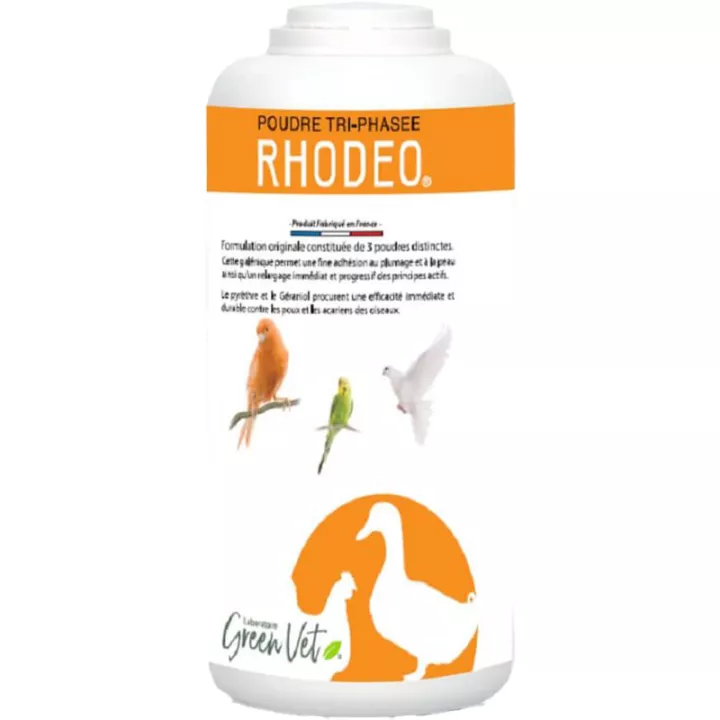
What is Rhodeo Avian External Powder 125g used for?
Rhodeo Avian Powderis a natural pest control product for birds and poultry. It is effective against fleas, ticks, and mosquitoes, as well as mites.Its formula adheres to the birds’ feathers and skin for maximum and continuous effectiveness.Rhodeo Avian External Powder 125g is effective against both insects (bird lice) and mites, particularly:
Dermanissus galinae, or red mite. Please note: in the event of a severe infestation, it may be advisable to treat the environment as well.
Rhodeo Avian Powder works effectively thanks to its formula specially developed for external application on birds and poultry. When applied, this powder adheres to the birds’ feathers and skin, creating a continuous protective barrier against parasites. Rhodeo Avian External Powder offers versatile protection by targeting several types of harmful pests, including:
Fleas can cause significant discomfort in birds and poultry. Rhodeo External Avian Powder is effective at controlling fleas, thereby reducing the risk of infestation.
Ticks can transmit various diseases to birds and poultry. This powder effectively repels them, helping to prevent infections.
Mosquitoes can carry diseases that are dangerous to birds and poultry. Rhodeo Avian External Powder offers protection against these biting insects.
Mites, particularly Dermanissus galinae (chicken mite), can cause serious health problems in birds and poultry. Rhodeo Avian External Powder is effective in controlling these parasites.
We also offer Teniverm deworming capsules at the best price in our online pharmacy.
How do you use this powder?
2 methods of administration: Direct application
Apply the powder all over the bird, focusing on the infested areas; in fact, bird lice attach themselves to a wide variety of locations: the breast, thighs, neck, head, back, and pericloacal area...
A dose of approximately 4 g of powder is needed to treat a 4 kg bird.
This is equivalent to one level tablespoon.
Indirect or self-treatment method
After an initial manual treatment or spot treatment, birds can self-treat. To do this, place and fill a basin with fine sand and/or ash, and mix the powder into the remaining 2 cm of sand at the following rates: 5 level tablespoons of powder for a diameter of 35 cm; 2 level tablespoons of powder for a diameter of 20 cm; 1 level tablespoon of powder for a diameter of 14 cm
This method is recommended when treating large numbers of birds (such as in canary breeding operations, etc.), for monitoring the treatment, and when the birds are difficult or even impossible to catch.
Safe for use on 3-day-old chicks and baby birds
Rhodeo avian powder does not kill lice eggs; a second application is required within 7 to 10 days following the first treatment.
N.B. This container can be buried so that it sits flush with the ground.
Withdrawal period:
Eggs = 0days; Meat = 5 days(for organoleptic reasons—potential residual odors or tastes).
Do not use Rhodeo powder directly in natural preening areas to protect the environment.
If swallowed, seek medical attention.
If the product splashes into the eyes, rinse thoroughly with water.
If the product is inhaled in large quantities, move the patient to fresh air.
Keep out of reach of children.
Do not use on cats (precaution).
What is its composition?
The powder is a three-phase powder that contains:
- 1 immediate-release powder (impregnated calcium carbonate) that selectively adheres to feathers and down
- 1 delayed-release powder (vegetable carbon) that selectively adheres to feathers and down
- 1 delayed-release powder (gelatin) that selectively adheres to the skin. Note that a hen has a high body temperature (42–43°) and that the melting point of gelatin is 28–30°
Composed of:
- Geraniol 2%CAS No. 106-24-1
- Dalmatian Chrysanthemate 0.8%CAS No. 89997-63-7
- Thyme/pine scent
- Excipients: calcium carbonate, vegetable carbon (coconut), impregnated gelatin
- Preparation type: 19 (repellents)
Packaging
125-gram bottle