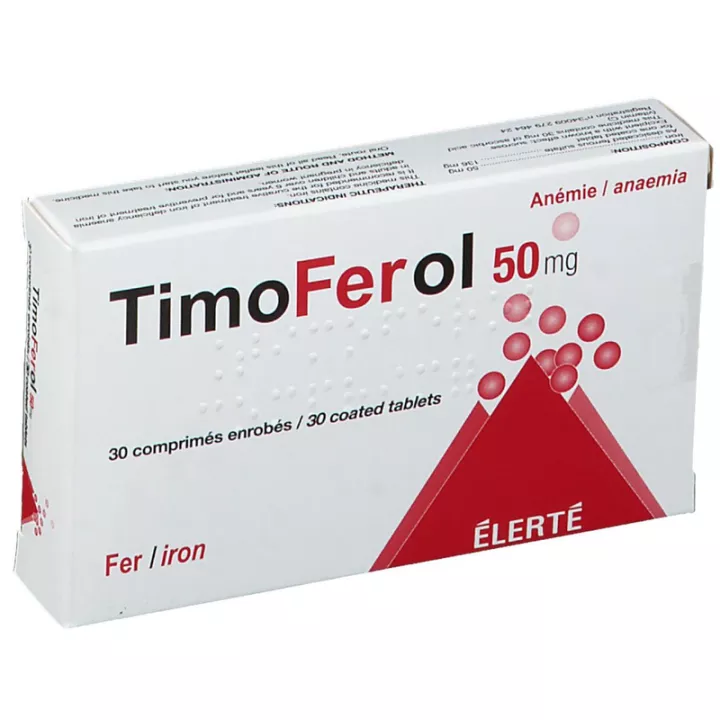
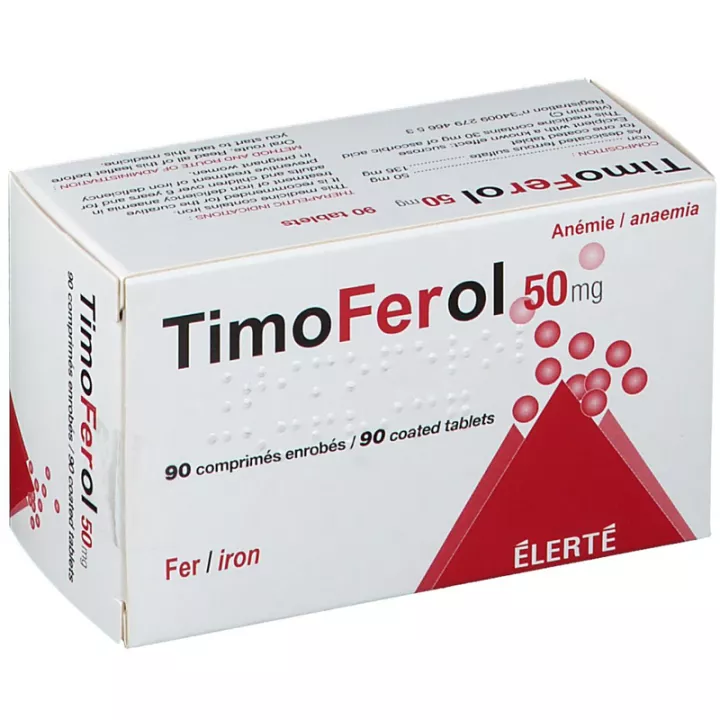
Timoferol capsule contains iron and is recommended for the curative treatment of iron-deficiency anemia in adults and children over 12, and as a preventive treatment for iron deficiency in pregnant women.
For warnings, precautions and contraindications, please consult the TIMOFEROL leaflet.
Most people with mild anemia don't notice it. The intensity of symptoms varies according to severity, type of anemia and speed of onset. When anemia appears gradually, symptoms are less obvious.
The most common symptoms that may suggest anemia are :
These symptoms should alert you especially if :
TIMOFEROL Iron + Vitamin C capsules contain iron and are recommended for the curative treatment of iron-deficiency anemia in adults and children over 12, and as a preventive treatment for iron deficiency in pregnant women.
Timoferol, from the ELERTE laboratory, is an iron-containing capsule specially designed for the curative treatment of iron-deficiency anemia in adults and children over 12. It is also recommended as a preventive treatment for iron deficiency in pregnant women. Find out how Timoferol can help you restore optimal iron levels and prevent the complications associated with iron deficiency.
Iron deficiency anemias are common and can lead to chronic fatigue, dizziness, pale skin and reduced concentration. Timoferol works by providing the body with the iron it needs to produce healthy, functional red blood cells. By taking this medicine regularly, you can help treat anemia effectively and regain your vitality.
Iron deficiency is common in pregnant women due to the increased need for iron to support fetal growth and maternal blood production. Timoferol is recommended as a preventive treatment to help prevent complications associated with iron deficiency during pregnancy, such as maternal anemia and low birth weight. Make sure you and your baby get enough iron with Timoferol.
Timoferol is available in easy-to-swallow capsules, suitable for use in adults and children over 12. Its specially dosed iron formula ensures optimal absorption by the body, providing effective treatment of anemia and effective prevention of iron deficiency. Incorporate Timoferol into your daily routine and regain optimal iron levels.
Timoferol is recommended by many healthcare professionals for its effectiveness in treating anemia and preventing iron deficiency. Whether you suffer from anemia due to iron deficiency, or are a pregnant woman concerned about maintaining adequate iron levels, Timoferol can help you achieve your health goals. Trust Timoferol from Laboratoire ELERTE to take care of your well-being.
Dosage:
Curative treatment: adults and children over 12. On average: 2 to 4 tablets a day.
Preventive treatment: for pregnant women: 1 tablet per day during the last two trimesters of pregnancy (from the 4th month).
In all cases, follow your doctor's prescription.
This medicine has been personally delivered to you in a specific situation:
Method of administration:
Oral route.
Frequency and timing of administration:
In order to limit undesirable effects and due to a stimulating effect of vitmaine C, it is advisable to take this drug on an empty stomach in the morning or before breakfast, but the time of intake and possibly the dosage should be adapted according to digestive tolerance.
Duration of treatment:
It should be sufficient to correct anemia and restore iron reserves (around 3 to 6 months).
In all cases, follow your doctor's prescription.
What to do in the event of overdose:
In the event of massive indigestion, consult a doctor immediately.
Composition in active ingredients (per capsule):
| Dried ferrous sulfate Corresponding quantity of iron |
172.73 mg 50.00 mg |
| Ascorbic acid | 30.00 mg |
Packaging: box of 30 or 90 tablets.
Warning: this medicine is not a product like any other. Read the package insert carefully before ordering. Keep medicines out of the reach of children. If symptoms persist, ask your doctor or pharmacist for advice. Beware of incompatibilities with your current products.
1. How long does it take to see results with Timoferol? Results may vary from person to person, but many users notice an improvement in their symptoms after a few weeks of treatment.
2. Are there any side effects associated with Timoferol? Timoferol is generally well tolerated, but side effects such as gastrointestinal upset may occur in some people. It is recommended to consult a healthcare professional in the event of any adverse reaction.
3. How should Timoferol be taken? It is recommended to take one capsule of Timoferol per day, preferably during meals, with a large glass of water.
Pharmacovigilance Report an adverse drug reaction(s)
NOTICE
ANSM - Updated on : 17/06/2022
Product name
Timoferol 50 mg, coated tablet
Sidebar
Please read this leaflet carefully before taking this medicine, as it contains important information for you.
You must always take this medicine in strict accordance with the information provided in this leaflet or by your doctor or pharmacist.
- Keep this leaflet. You may need to read it again.
- Ask your pharmacist for advice and information.
- If you experience any side effects, talk to your doctor or pharmacist. This also applies to any side effects not mentioned in this leaflet. See section 4.
- You should contact your doctor if you do not feel any improvement or if you feel less well.
What does this leaflet contain?
1. What is TIMOFEROL 50 mg, coated tablet and what is it used for?
2. What do I need to know before taking TIMOFEROL 50 mg, coated tablet?
3. How do I take TIMOFEROL 50 mg, coated tablet?
4. What are the possible side effects?
5. How do I keep TIMOFEROL 50 mg, coated tablet?
6. Package contents and other information.
1. WHAT IS TIMOFEROL 50 mg, coated tablet AND WHAT IS IT USED FOR?
Pharmacotherapeutic class - ATC code: Antianemic, Oral ferrous sulfate
This medicine contains iron.
It is recommended for the curative treatment of anemia due to iron deficiency in adults and children over 6 years of age, and as a preventive treatment for iron deficiency in pregnant women.
2. WHAT DO I HAVE TO KNOW BEFORE TAKING TIMOFEROL 50 mg, coated tablet?
Never take TIMOFEROL 50 mg, coated tablet :
- if you have iron overload, particularly in certain forms of anemia (thalassemia, refractory anemia, bone marrow failure anemia).
If in doubt, ask your doctor or pharmacist for advice.
Warnings and precautions
Tell your doctor or pharmacist before taking TIMOFEROL 50 mg, coated tablet:
- If you have difficulty swallowing.
- If you accidentally choke on a tablet, contact your doctor as soon as possible. If the tablet enters the airways, there is a risk of ulceration and narrowing of the airways. This can lead to persistent coughing, bloody coughing and/or shortness of breath, even if inhalation took place several days or months before the onset of symptoms. You should therefore seek urgent medical attention to ensure that the inhaled tablet has not damaged your airways.
- If your doctor has informed you of an intolerance to certain sugars.
Warnings
- This medicine is not suitable for the treatment of anemia associated with inflammatory diseases.
- A medical consultation is necessary before starting this treatment, in order to investigate the cause of the anemia.
Precautions for use
- High tea consumption inhibits iron absorption. This medicine should not be taken at the same time as tea.
- It is advisable to check the efficacy of this product after 3 months of treatment.
- Due to the presence of sucrose (0.182 g per tablet), this drug is not recommended for patients with fructose intolerance.fructose intolerance, glucose-galactose malabsorption syndrome or sucrase/isomaltase deficiency (rare hereditary diseases).
- This medicine contains 30 mg ascorbic acid (vitamin C). In order to limit undesirable effects, and due to the stimulating effect of vitamin C, it is advisable to take this medicine on an empty stomach in the morning or before breakfast, but the timing and dosage should be adjusted according to digestive tolerance.
If in doubt, ask your doctor or pharmacist for advice.
Children and teenagers
Not applicable.
Other medicinal products and TIMOFEROL 50 mg, coated tablet
Tell your doctor or pharmacist if you are taking, have recently taken or may take any other medicines, especially injectable medicines containing iron.
This medicine may reduce the absorption of other drugs.
TIMOFEROL 50 mg, coated tablet with food and drink
With tea (see precautions for use).
Pregnancy and breast-feeding
This medicine should be used during pregnancy only on the advice of your doctor.
This medicine may be used by nursing mothers.
If you are pregnant or breastfeeding, think you may be pregnant or are planning to become pregnant, ask your doctor or pharmacist for advice before taking this medicine.
Driving and using machines
Not applicable.
TIMOFEROL 50 mg, coated tablet contains sucrose.
3. HOW TO TAKE TIMOFEROL 50 mg, coated tablet
Dosage: for children over 6 and adults only.
Curative treatment:
- children over 6: 1 tablet per day,
- children over 12 and adults: 2 to 4 tablets a day.
Preventive treatment:
- pregnant women: 1 tablet per day, during the last two trimesters of pregnancy (i.e. from the 4th month).
In all cases, follow your doctor's prescription.
Method and frequency of administration
Take by mouth.
Take with a glass of water, preferably before or during meals, depending on digestive tolerance.
Duration of treatment
Sufficient to correct anemia and restore iron reserves (3 to 6 months).
In all cases, follow your doctor's prescription.
If you have taken more TIMOFEROL 50 mg, coated tablet than you should have
In case of massive ingestion, consult your doctor or pharmacist immediately, or seek emergency medical attention, especially if you are a child under 2 years of age.
Overdosage may cause intense irritation or death of digestive tissues (necrosis of digestive mucosa). The main symptoms are abdominal pain, vomiting and diarrhoea (often containing traces of blood), which may be accompanied by a rapid drop in blood pressure (shock), loss of consciousness with convulsions (coma), kidney disease (acute renal failure) and liver disease (hepatic impairment).
Longer-term digestive consequences may occur, with narrowing of the digestive tract (digestive stenosis).
If you forget to take TIMOFEROL 50 mg, coated tablet
Not applicable.
If you stop taking TIMOFEROL 50 mg, coated tablet
Not applicable.
4. WHAT ARE THE POSSIBLE SIDE EFFECTS?
As with all medicines, this drug may cause undesirable effects, but they do not occur systematically in everyone.
Digestive disorders such as nausea, constipation or diarrhea may occur.
Stools may be black or grayish-black in color.
Ulcerations of the throat or esophagus (the tube connecting your mouth to your stomach) may occur in all patients, but particularly in the elderly and patients with swallowing disorders. If the tablet enters the respiratory tract, there is a risk of ulceration of the bronchi (the main air passages of the lungs), which may lead to narrowing of the bronchi.
Reporting side effects
If you experience any side effects, please tell your doctor or pharmacist. This also applies to any side effects not mentioned in this leaflet. You can also report adverse reactions directly via the national reporting system: Agence nationale de sécurité du médicament et des produits de santé (ANSM) and the network of Regional Pharmacovigilance Centers.
By reporting adverse reactions, you are helping to provide more information on drug safety.
5. HOW TO CONSERVE TIMOFEROL 50 mg, coated tablet
Keep out of sight and reach of children.
Do not use after the expiration date indicated on the box.
No special storage precautions.
Do not dispose of any medicine down the drain or in the household waste. Ask your pharmacist to dispose of any medicines you no longer use. These measures will help protect the environment.
6. CONTENTS AND OTHER INFORMATION
What TIMOFEROL 50 mg, coated tablet contains
- The active substance is :
Fer........................................................................................................................... 50,000 mg
As dried ferrous sulfate.................................................................. 136,000 mg
For one coated tablet.
- Other ingredients: ascorbic acid, microcrystalline cellulose, colloidal anhydrous silica, magnesium stearate, corn starch, polyvinyl acetate, talc, sucrose, gum arabic, titanium dioxide (E 171), carnauba wax.
What TIMOFEROL 50 mg, coated tablet is and what it contains
This medicine comes in the form of white, coated tablets. Boxes of 30, 60, 90 and 120.
Marketing authorization holder
Laboratoires des Réalisations Thérapeutiques ELERTE
181-183 rue André KARMAN
93300 Aubervilliers
Marketing authorization holder
Laboratoires des Réalisations Thérapeutiques ELERTE
181-183 rue André KARMAN
93300 Aubervilliers
Manufacturer
Laboratoires des Réalisations Thérapeutiques ELERTE
181-183 rue André KARMAN
93300 Aubervilliers
Product names in member states of the European Economic Area
Not applicable.
The last date on which this leaflet was revised was :
[to be completed subsequently by the holder].
Other
Not applicable.
Detailed information on this drug is available on the ANSM (France) website.
Ce médicament contient du fer, élément minéral essentiel au fonctionnement de l'organisme. Le fer est nécessaire à la formation de l'hémoglobine, contenue dans les globules rouges, qui assure le transport de l'oxygène dans le sang.
Il est utilisé dans le traitement des carences en fer responsables de certaines formes d'anémies. Il est également utilisé pour prévenir cette carence chez la femme enceinte lorsque les apports alimentaires sont insuffisants.
Les prix mentionnés ne tiennent pas compte des « honoraires de dispensation » du pharmacien.
| p cp | p gél | |
| Sulfate ferreux | 136 mg | 136 mg |
| soit Fer | 50 mg | 50 mg |
| Saccharose | + |
Ce médicament ne doit pas être utilisé en cas d'excès de fer dans l'organisme.
Un apport en fer sous forme de médicament ne peut être décidé que par votre médecin. La quantité de fer contenue dans une alimentation diversifiée est généralement suffisante.
Une consommation importante de thé peut diminuer l'absorption du fer par l'organisme.
Ce médicament peut interagir avec les médicaments injectables contenant du fer.
Par ailleurs, respectez un intervalle de 2 heures entre la prise de ce médicament et celle des cyclines, des quinolones, des hormones thyroïdiennes, des biphosphonates, des pansements digestifs ou des médicaments contenant de l'entacapone, de la pénicillamine, du zinc, du strontium, de la lévodopa ou de la méthyldopa.
Ce médicament peut être utilisé pendant la grossesse ou l'allaitement uniquement s'il vous a été prescrit par votre médecin.
Ce médicament est mieux absorbé s'il est pris avec un verre d'eau avant les repas. Néanmoins, en cas d'intolérance, il est possible de le prendre au cours des repas.
En raison de la présence de vitamine C (30 mg par comprimé ou gélule), il est conseillé de prendre ce médicament plutôt en début de journée.
Si vous ne supportez pas ce médicament (troubles digestifs), prévenez votre médecin : il pourra vous proposer un autre traitement.
La reconstitution du stock en fer de l'organisme nécessite un traitement de longue durée (plusieurs mois) ; respectez la durée prescrite par votre médecin.
Les aliments les plus riches en fer sont d'origine animale : viande, poisson, volaille, abats.
Nausées, constipation, diarrhée.
La coloration noire des selles est habituelle et ne doit pas vous conduire à interrompre le traitement.
Baisse du taux d'hémoglobine dans le sang, qui se traduit le plus souvent par une baisse du nombre des globules rouges. Le fer est indispensable à la synthèse de l'hémoglobine. Une carence en fer lors d'une grossesse, d'un régime végétarien, d'hémorragies abondantes ou répétées (règles) est une cause fréquente d'anémie. D'autres causes, plus rares, sont liées à des carences en vitamines du groupe B.
Déficit concernant habituellement des nutriments, des vitamines, des sels minéraux, etc. Une alimentation diversifiée est la meilleure prévention des carences.
Ralentissement du transit intestinal se traduisant par la raréfaction des selles.
Consultez l'article : Constipation de l’adulte ou Constipation de bébé et de l'enfant
Famille d'antibiotiques utilisés notamment dans le traitement de l'acné et de certaines infections génitales.
Le sens médical strict de diarrhée est « émission de selles trop fréquentes et trop abondantes ». En fait, le sens commun assimile la diarrhée à la notion de selles liquides et fréquentes. Normalement, les selles sont pâteuses, mais l'émission de selles liquides ou à peine formées, sans douleur ou trouble particulier associé, n'est pas pathologique. On peut parler de diarrhée lorsque les émissions de selles liquides se répètent dans la journée, et que les besoins sont impérieux ou douloureux.
Beaucoup de médicaments peuvent accélérer le transit intestinal et rendre les selles plus liquides, sans que cet effet indésirable soit réellement préoccupant.
Les antibiotiques peuvent altérer la flore digestive, indispensable à la digestion, et provoquer des diarrhées plus ou moins gênantes mais bénignes. L'effet apparaît immédiatement ou après quelques jours de traitement. Une forme de diarrhée grave et exceptionnelle, la colite pseudomembraneuse, peut être observée après un traitement antibiotique ; cette affection se traduit par l'émission de glaires et de fausses membranes (ressemblant à des lambeaux de peau) associées à des douleurs abdominales ; une constipation peut remplacer la diarrhée initiale. La colite pseudomembraneuse peut survenir plusieurs jours après l'arrêt du traitement antibiotique et nécessite un avis médical urgent.
Consultez l'article : Diarrhée et gastro-entérite de l’adulte ou Diarrhée et gastro-entérite de l’enfant
Cellule présente dans le sang (5 millions par mm3), qui contient l'hémoglobine.
Synonyme : hématie.
Principal constituant des globules rouges, l'hémoglobine est une substance riche en fer qui assure la fixation de l'oxygène de l'air au niveau des poumons et sa redistribution dans les différents organes.
Voir aussi : anémie.
Famille d'hormones accélératrices du métabolisme, sécrétées par la glande thyroïde. Elles sont dosables dans le sang et sont appelées T3 et T4.
Effet indésirable, le plus souvent digestif, lors de la prise d'un médicament. L'irritation de l'estomac due à l'aspirine est une intolérance et non une allergie.
Médicament qui protège le tube digestif en tapissant la muqueuse d'un film protecteur et en diminuant l'acidité de l'estomac. Ce type de médicament peut gêner l'absorption d'autres médicaments.
Famille d'antibiotiques utilisés dans le traitement des infections urinaires, génitales, gastro-intestinales, respiratoires, etc. Elle contient, entre autres, la péfloxacine, la ciprofloxacine, l'ofloxacine et la sparfloxacine. Également appelés fluoroquinolones, ces antibiotiques sont efficaces sur un grand nombre de germes. Leur usage est contre-indiqué chez les femmes enceintes, chez celles qui allaitent et chez les enfants du fait de leur possible toxicité sur la croissance des cartilages.
Consultez l'article : Les quinolones.
Le saccharose est la substance qui compose le sucre de cuisine et le sucre industriel que l'on retrouve dans les biscuits, les gâteaux, les sucreries et les boissons sucrées (une bouteille d'un litre et demi de soda contient l'équivalent de trente morceaux de sucre). Certaines personnes sont intolérantes au fructose issu de la digestion du saccharose et souffrent alors de ballonnements et de diarrhée. Certains médicaments contiennent du saccharose comme excipient (composant sans activité thérapeutique).
Consultez l'article : Tous les glucides sont-ils équivalents ?
Traitement destiné à soigner une maladie déclarée, et qui vise la guérison. Dans la majorité des cas, le traitement curatif s'attaque à la cause de la maladie.
Traitement destiné à prévenir une maladie (synonyme : prophylaxie), ou à limiter la fréquence des crises ou des poussées dans une maladie chronique.
Ensemble de symptômes traduisant une irritation ou un mauvais fonctionnement du tube digestif. Un ou plusieurs troubles peuvent être présents : nausées, vomissements, aérophagie, douleurs abdominales, brûlures d'estomac, ballonnements, flatulences, diarrhée ou constipation, etc. Les antibiotiques peuvent favoriser les candidoses, souvent responsables de troubles digestifs.
Substance indispensable à la croissance et au bon fonctionnement de l'organisme. Les besoins en vitamines sont normalement couverts par une alimentation variée. Dans les pays développés, seule la carence en vitamine D, chez le jeune enfant ou le vieillard peu exposés au soleil, justifie une supplémentation systématique. Un apport supérieur aux besoins, par des médicaments notamment, peut être à l'origine d'un surdosage et de troubles divers (vitamines A et D essentiellement).
Consultez l'article : Les vitamines.